You are what you legislate

Thursday, August 14, 2014

Super, Super Fresh Chicken

Chicken is very popular in Tangier, both at restaurants and in home cooking. Above is cous cous, a traditional Morocco dish of semolina, vegetables and chicken with a sweet spiced onion relish.
 
This week I observed a small shop selling freshly slaughtered, plucked, and cleaned chickens directly to consumers. I’ve seen many of these in the older, more residential areas of the city, and this one was located in a bustling, very non-touristy neighborhood, much more traditional than the center city area where I live. It was a small space, about 15ft by 20ft, with an enclosed area in the front where approximately twenty live chickens sat calmly. It was squeezed between another chicken shop and a row of vegetables stands on a small, windy market street. I wanted to take a picture, but my Moroccan friend advised against it, saying it would attract a lot of attention and might be considered rude.


In contrast to the restaurant meal above, with a quarter of a chicken for one person, this photo shows homemade rfissa, another traditional Morocco dish, with half a chicken for eight people. While meat and chicken are included in many meals, the actual portion sizes in home-cooked meals are often small.
 
As I watched, customers approached the shop and asked for chickens of various sizes. The man working in front would choose a chicken and weigh it, then hold it by the wings with one hand in a position that kept it relatively immobilized. In full view of the customers, he would make a quick cut across the throat with a sharp blade, then place the body upside-down in a plastic cone to drain the blood. After a few minutes, the carcass was placed briefly in boiling water, then into a small machine, a 3’ by 3’ box with a circular opening. This machine appeared to remove most of the feathers; the rest of the feathers and the skin were removed by hand by the second man working in a shop. On a large counter, also in full view of the customer, he pulled off the skin, eviscerated the chicken, and cut it into pieces as specified by the customer. It was then wrapped up and handed to the buyer in a plastic bag. The price for a medium-sized chicken was 47 dirhams, about $6.


Chicken is especially popular in fast food restaurants. The restaurant advertised above is a chain, but many are small independent businesses selling fried or roasted chicken for quick snacks and meals.

You can also buy cleaned whole chickens and pieces in the large fresh produce and meat market in the center of the city and from small butcher shops in residential neighborhoods, for about the same price, and from supermarkets, which are slightly more expensive. I would like to find out more about where chicken is sourced for restaurants, especially the larger chain restaurants. For some of the small shops, it would be feasible to meet all their needs with this type of local, urban supply chain. I imagine that larger restaurants look to more industrial suppliers that bring in slaughtered, cleaned, and pre-cut chickens from outside the city – I saw some large, highly concentrated chicken farms on a drive between Tangier and Rabat. There are also even larger chains, like McDonald’s, which sells hundreds, if not thousands of servings of chicken nuggets per day. I would be curious to know where their chicken comes from – Tangier? Morocco? Imports?

No matter where it comes from, chicken is a popular part of Moroccan cuisine, and it will be interesting to see how demand will be met as populations, incomes, and consumption rise.

Saturday, August 9, 2014

Advertising Part !!: Ramadan Themes


The Holy month of Ramadan took place from June 29 to July 28, bringing with it a sense of tranquility and spiritual awareness, as well as new opportunities to sell high-fat, high-salt Western restaurant meals to Moroccans. It was a perfect example of how international food corporations adapt products and marketing strategies to local conditions.

Some billboards, like the one for tea above, used more general Ramadan motifs - dates, the moon. The McDonalds ad below, located on a busy section of the main boulevard, also used the month in a more general sense to promote "Ch'hiwates Ramadan" (ch'hiwates translates roughly to snacks).


Others targeted very specific Ramadan traditions as points of entry for new products. I found the following two ads particularly striking. During Ramadan, the fast is traditionally broken with a family meal centered around harira (a tomato soup with noodles and chickpeas) accompanied by hard boiled eggs, chabakia (fried pastries soaked in honey), and dates, as it was the habit of the Prophet Mohamed, peace be upon him, to break the fast with dates. This home-cooked, highly symbolic meal is eaten in nearly the same form every night of Ramadan, although there are often slightly different small savory dishes each night. Thus, it is striking to see Pizza Hut present its products as a part of the ftour meal, accompanied by a tall glass of Pepsi. Several of my Moroccan friends reacted negatively to this ad, explaining that you would never drink carbonated beverages to break the fast, and that the idea of a Pizza Hut ftour did not really fit with their idea of Ramadan.


A fried chicken chain also adopted this concept, offered a complete ftour menu with harira, eggs, dates, bread, milk, and an entire chicken. This ad also uses Islamic and Moroccan cultural motifs, including the crescent moon and the chicken dressed in a kandora, a traditional male garment.

There are many examples of cultural adaptation in advertising practices, but the blatant use of an largely Eastern religious and cultural holiday for the purpose of advertising largely Western food products and companies made it particularly apparent.

Wednesday, July 9, 2014

Food Marketing Part 1: Television Advertising


Over the past three weeks I have made informal studies of television advertising for food products. I noted what types of food ads I saw while watching World Cup soccer games on an Arabic language channel, and while watching “Ramadan Series” – sitcoms lasting the thirty days of Ramadan.

During the World Cup games (played on a field surrounded by Coca-Cola and McDonald’s logos), I saw ads for Lay’s potato chips, Boom Boom and Power Horse brand energy drinks, and Pepsi, which featured Argentine superstar Lionel Messi. These foods all fall, obviously, into the junk food/highly processed category.

This was an interesting contrast to the types of ads I observed during the Ramadan series, which I watched for four nights consecutively from approximately 8 to 9pm, just after the break fast meal. The most heavily advertised product was actually flour, including three major brands ( Nor’Dar, Moony, and May Mouna) running ads at least twice. The second most heavily advertised product was processed cheese, including four brands (La Vache Qui Rit, Kiri, Or Blanc, and Jebli) running ads once or twice during the one hour time period. The third most heavily advertised type of product was tea, including two brands each running multiple ads. Less-processed dairy, including two brands of yogurt (Danone and Activia) and a ready-to-eat strawberry smoothie (intended for serving at home) were also promoted. Other frequent ads were for bouillon cubes (two brands), Lio cooking oil, jarred tomato sauce, C-Bon energy drink mix, Valencia brand bottled juices, Dari dry pasta, and Ain Ifrane bottled water.


Overall, I saw ads for twenty different brands. Out of these twenty brands, half also have print ads on buildings or billboards in the city of Tangier: May Mouna flour, La Vache Qui Rit and Jebli cheese, both yogurt brands, the strawberry smoothie mix, one brand of tea, Valencia juice, Dari dry pasta, and Ain Ifrane bottled water. In the case of Jebli, May Mouna, Activia, and the smoothie mix, there were similarities between the television and print ads – same actors, motifs, etc. – indicating that advertising campaigns for these products are broad and include multiple types of media.


In the next few weeks, I will be analyzing print ads for food products on buildings and billboards in the city of Tangier.

Wednesday, June 25, 2014

Field Trip: Chefchaouen


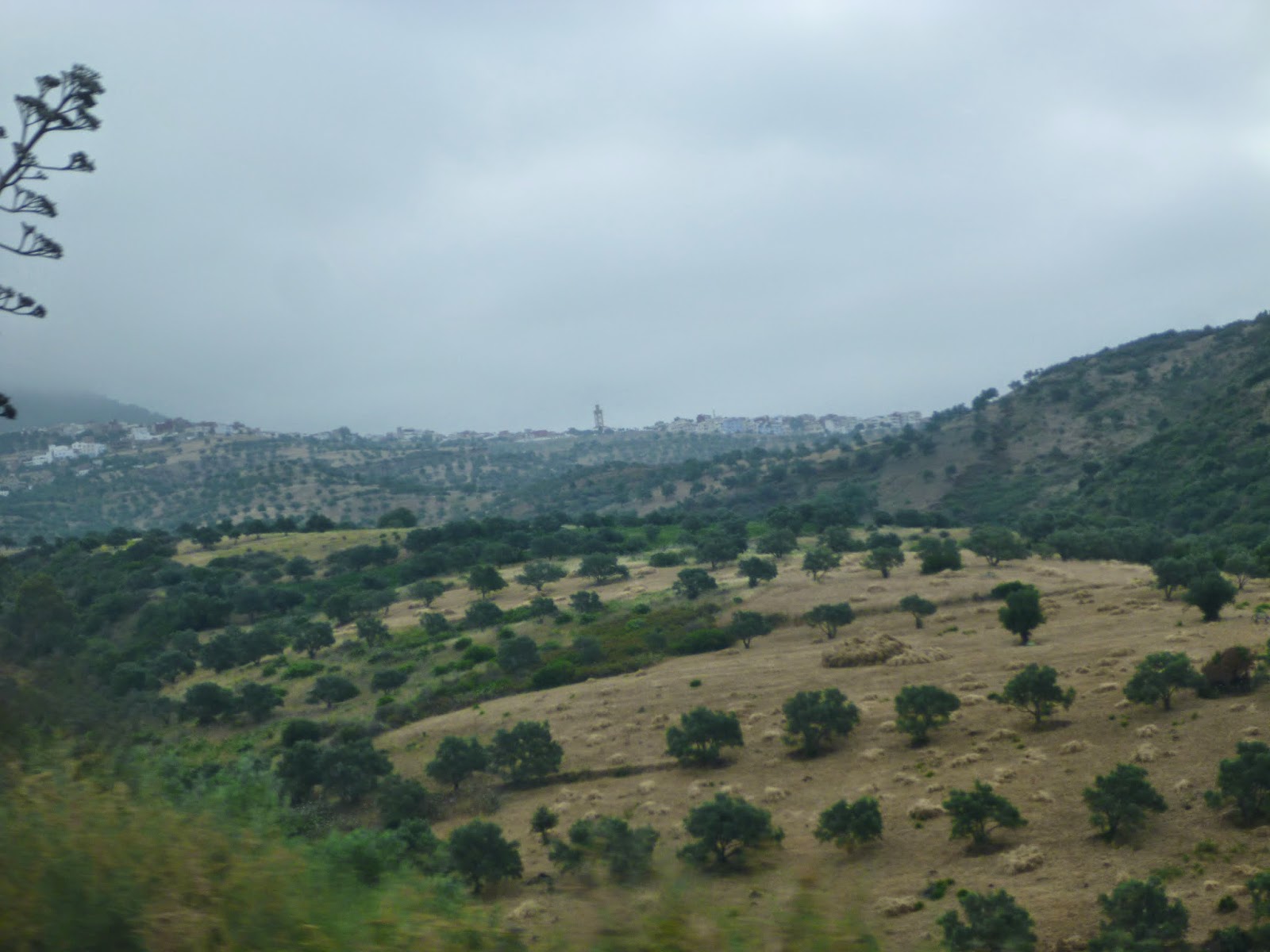
This week I visited the town of Chefchaouen, about two hours south of Tangier, Morocco. Once we got out of the large urban center, the landscape turned into mountainous farm country. Both sides of the road were dotted with small farms, most characterized by a one-family home situated on a plot of land with some crops and some grazing animals.


Crops
I saw four predominant crops: olives, hay, corn, and onions. The olive orchards were extensive, stretching across wide hillsides. Hay – some type of wheat-like grass, I wasn’t sure exactly what it was – was grown on most of the farms, in relatively small fields. Corn, too, was grown in relatively small fields on some farms, not in the type of endless expanse we see in the Midwest. Similarly, onions were being grown on small-scale farms, some in plots as small as 20x30 feet. Other crops that I did not see growing in fields but were particularly prominent in local markets were cherries, small plums, and figs.


I saw a lot of hay being harvested during the drives to and from Chefchaouen, and my friend explained why: in November, there is a festival called Eid Al-Kabir in which nearly every household slaughters a ram. With just four months to go, everyone is trying to fatten up their sheep as much as possible, thus the need for lots of hay.


Animals for Food and Transport
Animals are an important part of agriculture in Morocco, and most farms I saw had both crops and livestock. I saw sheep, cows, and goats grazing on hillsides and in farm fields alongside crops. Some farms had a herd of just one type of animal, but many had a mixture: one or two cows and small herds of sheep and goats. Many farms had chickens roaming freely as well. All four types of meat are popular in Morocco, especially beef and chicken. Cows are important for milk production, as are chickens for eggs; sheep hides are used for decoration and warmth in homes.


Much of the meat eaten in this area is raised and slaughtered locally. On the way back to Tangier, were stopped at a restaurant in a small town for lunch. There was a butcher shop connected to it, and a young man was in the process of delivering a dozen whole ram carcasses. He wore a white smock and carried them in two by two, slung over his shoulder, while my companions ate roasted mutton and grilled ground beef. I asked the butcher if the sheep were coming from this area. He said yes, from the mountains, and pointed to the slopes visible out the front door of the restaurant.


Animals are not just raised for meat. Nearly every farm I saw had a donkey, and they are even used to transport goods in smaller cities where the streets are too small for motorized vehicles. They carry everything from bundles of hay to propane tanks to crates of orange juice bottles to small children. I also saw donkeys used for threshing grain – three animals tied together were walked in a circle on a large pile of grain stalks.


Mechanization
The majority of the farms I saw were using primarily human and animal labor to harvest grain and other crops. On some farms, men, women and children were harvesting by hand with large knives and piling the grass onto donkeys. On one larger farm, a combine was driving up and down the field harvesting grain. I mostly saw threshing of grain with fuel-powered threshers, but I did see one team of donkeys, too. I saw mechanized hay balers on multiple farms as well. Based on the gernerally low level of mechanization on many farms and the small number of farm machines I saw, I assume that in most cases the farmers do not own the balers or threshers, but hire them when needed. 


Markets in Chefchaouen
I noticed two basic types of produce vendors in the city of Chefchaouen. One type was a vendor offering at least ten types of fruits and vegetables, from a combination of local, regional, and international sources. These included things like peaches and nectarines, bananas, apples, oranges, pears, avocados, tomatoes, and peppers. These types of vendors displayed their produce in crates, and some of the fruit even had stickers on it.


 The second type of vendor was characterized by a smaller selection – one to six types of produce, less inventory, and a specific set of local, seasonal items. This included small green plums, cherries, figs (lots!), cucumbers, zucchini, onions, herbs, milk, and olive oil. 


Vendors rarely sold more than four or five types, and sometimes displayed just one small buckets of figs. They were situated in the narrow streets in the old part of the city, rather than in one of the market plazas, and often sat on blankets on the ground or on small stools.


Conclusion
Much of the agriculture in the mountainous region near Tangier takes place on small family farms that have a mixture of crops, especially hay, corn, olives, vegetables, and tree fruits, and livestock, including cows, sheep, and goats. Much of the meat, milk, and fresh produce is consumed locally and varies with the season. Much farm work is done by hand or with the aid of donkeys, although some farms employ machinery for harvesting, baling, and threshing.


Seaonality Apparent

The seasonality of fruit is evident here in a way it is not in American supermarkets, where apples, oranges, pineapples, and strawberries are available year-round, albeit in mediocre quality. When I first arrived in Morocco in late February, strawberries were literally everywhere, spilling out of crates in market stands and piled in wheelbarrows for less than 50¢ a pound. Oranges, too, were cheap and easy to find. 

Oranges were everywhere in late winter
  Over the next few weeks, various types of fruit appeared and disappeared: cherimoyas from March to May, cactus fruits for a few brief weeks in April, and a strange apricot-like type from March to April. Melons arrived in late April, followed soon after by the first stone fruits: cherries and tiny plums. In mid-May, we started to see apricots, peaches, and nectarines. Last week, in early June, fresh figs arrived! The green ones came first, followed a few days later by black ones.

Cactus fruits made a brief appearance in April
 Prices changed to reflect limited supply and high demand: the first cherries I saw in the market were 27 dirham (about $3.25) per kilo, the next day they dropped to 15 dirham and stayed at that price for the next few weeks. Similarly, strawberries were 10 dirham per kilo for weeks, but crept up to 12 and 14 dirham per kilo near the end of the season. Interestingly, the prices then dropped to 8 for the rare crate I did see - it seemed that no one wanted out of season strawberries.


A mysterious apricot-like spring fruit
 After seeing the changes in the fruit available in the markets, I realized that I had only vague ideas of what is in season when in my state, Minnesota. I did some reading and was surprised to learn how much we can grow. In the spring, mostly salad greens and some early vegetables, such as cauliflower, peas, potatoes, radishes, asparagus, sprouts, and rhubarb are in, many lasting into June, July, and August. We have a huge range of vegetables available in the summer, everything from bell peppers to sweet corn, beans, tomatoes, summer squash, eggplant, Brussels sprouts, celery, carrots, and cucumber. Minnesota produces a surprising amount of fruit as well, including apples, berries, melons, grapes, and plums.

Melons appeared in late April and early May
We can find lots of these same vegetables and fruits in early fall, and as the cold weather begins, we get winter squash, pumpkins, and more apples! While not much is growing during the winter, fruits and vegetables that store well, such as winter squash, apples, potatoes, turnips, beets, carrots, onions, and garlic are available.  

Delicious nectarines in late spring
 Of course, in Minnesota, we import much of our fresh produce. Avocados, bananas, and lemons are always in season somewhere, and thus always available. In the spring, cherimoyas, apricots, citrus, and mango appear. In the summer, berries, peaches and nectarines, pears, and melons from other parts of the country proliferate.  In the fall, we get persimmons, pomegranate, quince, passion fruit, guava, and grapes, giving way to dates, kiwis, chestnuts, clementines, tangerines, oranges, and papaya in the winter.

Figs in the first few days of June
 Why does seasonality matter? Many people will tell you that fruits and vegetables in season taste better. When fruit needs to be shipped long distances, it often loses flavor as well as nutrients. Buying in season also lets you buy local, which often, but not always, means less energy used for transportation. Finally, it offers a different kind of connection to food, one that is lost in our sterile, brightly lit supermarkets. It reminds us of the changes in the seasons and the rhythms of place, creating a deeper sense of belonging to that place. I never feel more Minnesotan than when I'm eating sweet corn in late July, or biting into a crisp Haralson apple on an equally crisp October day, or roasting local squash on a cold December evening. Local, in season fruits and vegetables are one of the things I'm looking forward to most when I head back to the States in a few months.

Local squash from the Minnesota Landscape Arboretum

Wednesday, June 11, 2014

Types of Markets

Tangier, a city of over one million people, is served by many different types of food shops and markets. Based on my observations over the past three months, they fall into about a dozen categories.


Super Markets
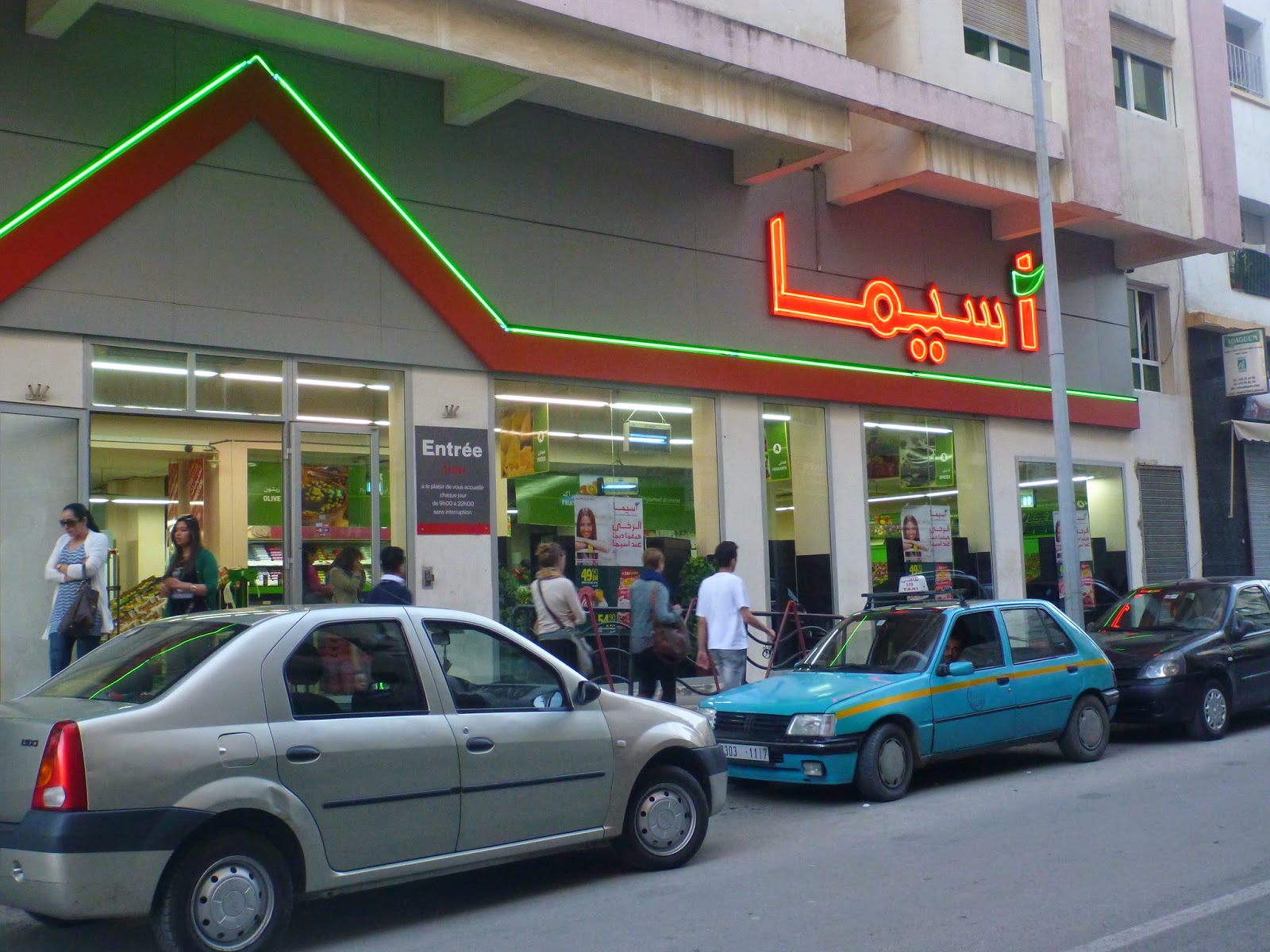
Super markets are quickly becoming the norm for food purchases in the developing world. In Tangier, western-style grocery stores stock a wide variety of fresh and processed foods, imported brands, and household and cleaning needs. Most have similar layouts to American chains, with sections for fresh produce, milk, meat and fish, bakery, deli, dry goods, and household supplies. The sizes vary: some independent neighborhood grocery stores are relatively small, some Wal-Mart style super markets located on the outskirts of the city are massive and offer consumer goods such as electronics and sports equipment in addition to groceries. Regardless of the size, all stores of this type are characterized by a formal price system, shopping carts and cashier lanes, and Western-style layouts with tile floors and bright lighting. However, many other types of shops and markets persist.


Alimentation General
Alimentation General translates to “general food store.” These shops, found in every neighborhood, are the go-to places for basic daily needs. They are relatively small and carry mostly dry and canned goods, some processed and snack foods, oil, milk, fresh bread, eggs, cheese, juice, usually some fresh fruits and vegetables. They also have things like laundry detergent, dish soap, and shampoo. They are usually less expensive than the supermarkets.


Central Covered Market
The large central market offers fresh fruit and vegetables, meat, fish, eggs, cheese, and olives. There are dozens of vendors within a large building, and each vendor usually offers a specific type of product: either fruit or vegetables, olives, chicken and eggs, or beef. Cheese is mostly sold by individual women with small informal stands within the market. Produce and meet are usually less expensive than the supermarket, but not always.


Street Vendors
In addition to the central market, fresh local fruit, vegetables, and cheese are also sold in less formal street stands, either on wheeled tables, blankets, or out of vans or trucks. These vendors are always less expensive than the supermarket and usually less expensive than the central covered market as well.


Fruit sec
Known as fruit sec, which means “dried fruit” in French, these small shops and stands sell  mostly processed snack foods, chips, candy, and cookies, as well as nuts and dried fruit. Most items cost less than a dollar, and for 10-25¢ you can buy a small scoop of nuts or sunflower seeds wrapped in a paper cone. You can find one on nearly every street, and on the busy main boulevard, most blocks have two or three.


Laiterie/Milbana/Cremerie
These types of shops, known as a laiteries or cremeries (literally milk store or creamery) in French and a milbanas in Moroccan Arabic, sell a variety of quick, inexpensive, on the go meals and snacks. The most common  offerings are sandwiches made with traditional Moroccan breads – hobz makalah, harcha, or erghraygef – filled with fresh cheese, butter, hard-boiled eggs, mortadella, olive oil, or nut butters. These types of sandwiches usually cost between 5 dirham (about 60¢) and 15 dirham. They also sometimes offer fresh juices and pastries, and some have processed snacks and bottled juices as well.

 
Sandwich Shops
Somewhat similar to the Laiteries, sandwich shops sell quick meals and snacks, mostly sandwiches made with eggs, chicken, liver, shrimp or beef, topped with vegetables and French fries. Prices ranges from 10 dirham (about $1.20) to 30 dirham.


 They are very popular and quite tasty.


Bakery/Patisserie
There are many bakeries in Tangier, offering fresh bread, cakes, cookies, and pastries. They are multiple types - the largest kind is a western-style store with at least a dozen varieties of fresh bread, both Moroccan styles and French styles like baguettes. They will also offer many kind of cookies and pastries. They vary in price but tend to be a little more expensive. 


A second type of bakery is the small street stand. These specialize in griddle-cooked Moroccan breads such as erghaygef and harcha, and usually offer honey, cheese, nut butters, and olive oil as accompaniments for a quick snack. Some offer soups or simple fish dishes as well, which can be eaten while standing there or wrapped up to go. 


A third type of patisserie specializes in the popular deep-fried treats that are popular here. They usually have some baked cookies as well, but the focus is the huge platters of golden-brown swirls of dough, fried and then soaked in a sugar-honey syrup.


Butchers

In some of the more residential areas, you can find stand-alone butcher shops not connected to a larger market. These tend to sell either beef or chicken, usually not both. Many also sell lamb or mutton. They often sell fresh vegetables too, making them easy stops for all the ingredients needed for home cooking.


Most of the meat arrives in large pieces – whole sides of beef are delivered to the shop and displayed, being cut and wrapped in paper as the customer purchases it rather than pre-cut and displayed in plastic wrap. Chickens are often sold whole, although you can easily find smaller pieces.


As pigs are haram - prohibited in Islam - it is almost impossible to find fresh pork, although you can find processed ham at import grocery stores.
 
Specialty vendors – in addition to stores selling many types of food, there are stands and shops that sell just specific items, such as dates or spices. These are mostly found in the market district of the old city.

 
In addition to these types of markets and snack shops, there are hundreds of simple cafés, serving little other than tea and coffee, upscale cafés with full menus, and a wide range of sit-down restaurants.

Wednesday, May 14, 2014

Current Events: EU Mango Ban

As of May 1, the European Union banned imports of Indian mangoes until December 2015. The ban comes after 200 shipments infested with fruit flies were discovered in Brussels in 2013, and extends to eggplants, two kinds of squash, and taro leaves. The EU claims that Indian exports are not sufficiently treated to reduce the risk of insect infestation; Indian officials say that a better examination and certification procedure has been put in place since the country was notified of the sanctions in March of this year. India, which produces forty percent of the world's mangoes, has threatened to take the case to the World Trade Organization.

The ban has wide-ranging impacts.

With a reduction in exports, Indian mango prices have dropped by fifteen to forty percent. This is good news for Indian mango consumers, who now have access to the higher-quality export product at lower prices. Especially prized are the Alphonso mangoes, now within reach for many middle-class consumers. Lower prices are not so good for farmers, who have already been hurt by unseasonal rain and hail leading to crop failure, or for the small-scale vendors now operating in a flooded marketplace.

However, the effects of the ban are limited because the EU is not the major destination for mango exports. In the 2012-2013 season, India produced 15 million metric tons, just 55,600 of which were exported. Of this fraction, less than ten percent went to EU countries. Most exports go to the Middle East, where there is a large Indian population. Over two seasons though, the ban could represent $10 million in losses for farmers, and will be particularly hard-hitting in the state of Maharashtra, which exports thirty percent of its crop to the EU. Some UK politicians are also concerned about the effect the ban will have on British importers and retailers of the fruit, which is especially popular there.

Other factors play into the low prices. Due to climactic changes affecting the fruit, farmers have been picking mangoes earlier and sending too many to the market. The global recession has also resulted in fewer shipments as corporate gifts, which make up a large percentage of business for some wholesalers.

Citing improved phytosanitary measures to control fruit flies, India has asked the EU to lift the ban; several British MP's have stated their support for a reversal of the restrictive measures.

Since the topic is mangoes, here is a recipe for delicious gazpacho, the perfect thing to cool down heated trade relations.


Mango Gazpacho with Mango Chutney (thanks to Ani at Whole Foods Market!)

  • 1 cup mango juice
  • 2 ripe mangos, peeled, pitted, and diced
  • 1 shallot
  • ½ cucumber peeled, seeded and diced
  • 1 cup blanched almonds
  • 2 tablespoons sherry vinegar
  • 10 fresh basil leaves
  • 6 mint leaves


Directions

1. The night before, place the almonds in a bowl and pour the juice over them. Allow to soak overnight.

2. The next day, place all ingredients in a blender and blend until it reaches desired consistency – less for chunky soup, longer for smoother.


If desired, serve with mango chutney: combine 8 oz. chopped dried mango, 1½ cups brewed black tea, ¼ cup raisins, 1 diced red onion, and ½ cup red wine vinegar in a saucepan. Simmer until the mixture is thick and the mangos have absorbed some of the liquid. The warm, sour chutney is a lovely contrast to the cool soup.


If you have extra chutney, use it in a grilled cheese with aged white cheddar and multi-grain bread!